
Applying for NSFAS can be overwhelming and might feel a little bit scarier as it’s exciting since it is somehow tied to your academic future. In this guide I will break down the 2026 application process step by step, so you know exactly what to do from start to finish avoiding costly mistakes.
What is NSFAS?
NSFAS (National Student Financial Aid Scheme) provides financial support to academically deserving and financially needy students at public universities and TVET colleges in South Africa. Funding covers tuition fees, accommodation, books, transport, and a living allowance for qualifying students.
1. Confirm You’re Eligible
Before applying you should ensure that you meet the following basic requirements:
- You must be a South African citizen
- Your household annual income must fall within NSFAS threshold which is R350 000, R600 000 for disabled students
- You must be enrolling in an NSFAS-funded qualification at a public university or TVET collage
You can find more info in this document (click the word/link “document” to access the pdf) which is found in the official site of NSFAS.
2. 2026 Window Opened
For the 2026 academic year, NSFAS opened its application window around mid-September 2025 and closed in the mid-November 2025. While the window has already closed, knowing this timeline helps you prepare for the next cycle which is for 2027 academic year, this means you’d probably apply for 2027 academic year during this period in 2026. Please note, late NSFAS applications might be opened for TVET collage students, refrain from applying if you’re enrolling at varsity as your funding would be revoked at a later stage, this is based on experience by a friend.
This means you should monitor NSFAS official communication channels such as social media accounts and the official site, nsfas.org.za to ensure early, smooth application process.
3. Documents to Prepare
Before you apply ensure you have the following documents:
- A South African certified ID copy, if you’re a minor you can submit both your parents/guardians ID copy (certified).
- Proof of income which would be used to determine eligibility. Documents to submit include your parents/guardian’s payslip, UIF, pension slip or affidavit if unemployed. If you’re SASSA beneficiary you can submit child support slip, disability grant statement and etc. Submit every document required as possible, if you’re SASSA beneficiary, you can assume NSFAS got it.
- Filled NSFAS consent form which is to be accessed from NSFAS official site.
Ensure that you have a working cellphone number and email which you will use throughout the application process, use your own contact details as confidential information will be communicated and managed through them.
5. Create and Use Your myNSFAS Account
To apply:
- Visit www.nsfas.org.za
- Click myNSFAS Login
- Register using your South African ID and create a secure password

This account will also be your hub for status updates and appeals.
6. Fill in Your Application
Once logged in:
- Enter personal details (name, ID, contact information)
- Upload supporting documents (IDs, proof of income, guardianship forms if applicable) NSFAS
- Make sure every field is accurate — small errors can delay processing.
Use clear PDFs, PNG and JPEG images where required. Avoid heavy scanned or blurry PDFs as it can negatively affect your application.
7. Submit and Save Your Reference Number
After submission, NSFAS gives you a reference number. Save it somewhere safe, you’ll need it to check your application progress. Other varsities such as Rhodes University might also need it.
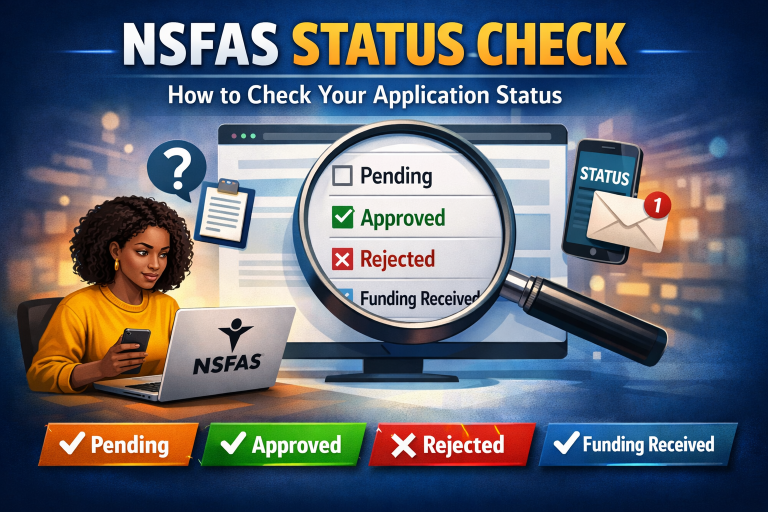
After applying, the next step is checking your status and submitting outstanding documents when required, which I covered in this linked guide: NSFAS Status Guide 2026.