

When I was in matric in 2022, applying for Medicine at the University of Cape Town (UCT), the National Benchmark Test (NBT) was one of the most stressful parts of my application process. Like many learners, I initially underestimated it, assuming that strong matric marks alone would be enough.
I quickly learned that the NBT plays a much bigger role than most schools explain.
This guide is written not only from research, but also from personal experience, to help you understand what the NBT is, why it matters, how to prepare properly, and how it fits into the broader university application process.
What Is the National Benchmark Test (NBT)?
The National Benchmark Tests (NBTs) are standardised assessments used by South African universities to evaluate whether students are academically prepared for university-level study.
Unlike matric exams, which focus on syllabus content, the NBT tests:
- Academic literacy
- Quantitative reasoning
- Mathematical understanding
- Problem-solving skills
When I applied to UCT, my matric marks were competitive, but the NBT helped the university assess how I would cope academically, especially in a demanding programme like Medicine.
Why Universities Use the NBT
Universities use the NBT to:
- Identify students who may need academic support
- Decide between mainstream and extended programmes
- Compare applicants fairly across different schools and backgrounds
From my experience, two students with similar APS scores can perform very differently in the NBT. That’s why universities often consider both APS and NBT results together.
You can read more about how APS scores work in this guide on how to calculate your APS score for South African universities.
Types of NBT Tests
There are two NBT tests, and not all applicants need to write both.
1. Academic and Quantitative Literacy (AQL)
This test measures:
- Reading comprehension
- Logical reasoning
- Understanding academic texts
- Interpreting graphs and data
Almost all degree programmes require the AQL test.
2. Mathematics (MAT)
The MAT test is required for maths-intensive courses such as:
- Medicine
- Engineering
- Science
- Commerce
When applying for Medicine at UCT, the MAT test was non-negotiable, and it required far deeper understanding than school exams.
Who Must Write the NBT?
You are likely required to write the NBT if:
- Your chosen university requires it
- You are applying for competitive programmes
- You are applying to institutions like UCT, Wits, or Stellenbosch
Always confirm requirements on the official university website, as they differ by course and institution.
When Should You Write the NBT?
One of the biggest mistakes I nearly made in matric was waiting too long to write the NBT.
Writing early:
- Reduces pressure
- Gives you time to rewrite if necessary
- Ensures results are available before deadlines
- Helps with late or second-round applications
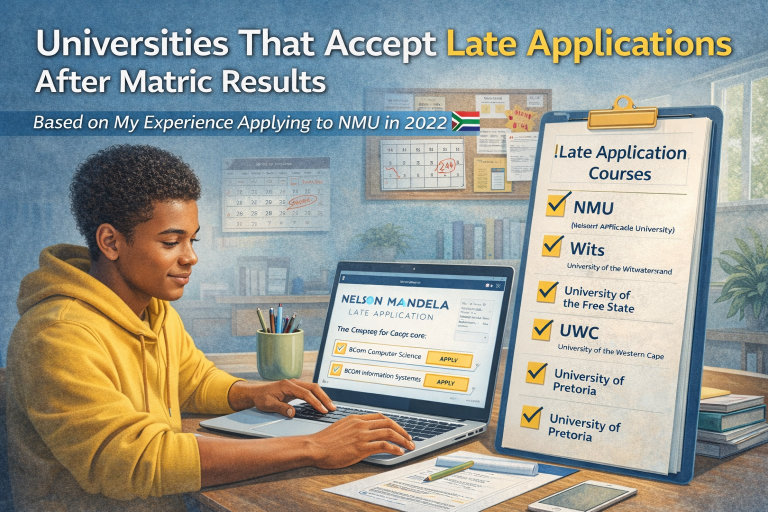
This becomes especially important if you plan to submit late university applications after matric results are released.
(Link to late applications post)
How to Register for the NBT
NBT registration is done online through the official NBT platform.
You will need:
- A valid South African ID or passport
- An email address
- Payment for the test fee
Once registered, you receive your test date, venue, and instructions.
How the NBT Is Scored
NBT results are not given as percentages. Instead, they are grouped into performance bands, such as:
- Proficient
- Intermediate
- Basic
When I received my results, I realised universities use these bands to:
- Decide on admission
- Recommend extended programmes
- Identify areas where students may need academic support
How to Prepare for the NBT (What I Wish I Knew)
1. Understand the Test Format Early
The NBT is not about memorising content. It tests:
- How you think
- How you interpret information
- How you apply concepts under time pressure
Once I understood this, my preparation became much more effective.
2. Improve Your Reading Skills (AQL Test)
NBT reading passages are longer and more complex than matric texts.
Helpful habits:
- Read articles and academic-style texts
- Practice identifying arguments and main ideas
- Summarise what you read in your own words
This helped me significantly with the AQL section.
3. Practice Time Management
Time pressure is one of the biggest challenges.
Tips:
- Practice answering questions with a timer
- Don’t get stuck on one question
- Learn when to move on
Speed without accuracy doesn’t help — balance is key.
4. Strengthen Core Maths Concepts (MAT Test)
For the MAT test, focus on:
- Algebra
- Fractions and ratios
- Graph interpretation
- Functions
- Word problems
For Medicine applications, understanding concepts deeply mattered far more than knowing many formulas.
5. Avoid Last-Minute Cramming
The night before my test, resting helped more than studying.
Instead:
- Sleep early
- Eat properly
- Arrive calm and prepared
A clear mind performs better than an exhausted one.
Common NBT Mistakes Students Make
From what I’ve seen over the years, common mistakes include:
- Writing the test too late
- Not checking course-specific requirements
- Panicking during the exam
- Underestimating the MAT test
Good preparation removes unnecessary stress.
How the NBT Fits Into the Bigger Picture
The NBT is one part of your application.
Universities also consider:
- Your APS score
- Your subject choices
- Availability of space
- Programme competitiveness
If you are applying for financial assistance, understanding how these factors work together is also important.
(https://uni-diaries.co.za/how-to-apply-for-nsfas-in-2026-step-by-step/)
Final Thoughts
Writing the NBT in matric while applying for Medicine at UCT taught me that strong marks alone are not always enough. Universities want to know whether you are ready for the academic demands ahead.
With early planning, proper preparation, and realistic expectations, the NBT becomes manageable rather than intimidating.
Disclaimer
This article is based on personal experience and general information. NBT requirements and university policies may change. Always confirm the latest requirements with the relevant university or the official NBT platform.